
HGTECH 武汉华工激光工程责任有限公司 privacy policy
Copyright HGLaser Engineering Co,.Ltd. All Rights Reserver.
As EV traction motors continue to evolve toward higher efficiency and greater power density, the quality of winding connections has become increasingly critical. Hairpin technology is widely adopted because it offers a higher slot fill factor and improved electrical performance compared with conventional round-wire windings. However, the larger conductor cross-sections and compact end-winding structures also create significant joining challenges. Traditional welding methods often struggle to maintain consistency and reliability under these conditions. Hairpin laser welding addresses these challenges through precise and controllable energy input, enabling high-quality electrical and mechanical connections while supporting the demanding requirements of modern motor manufacturing.
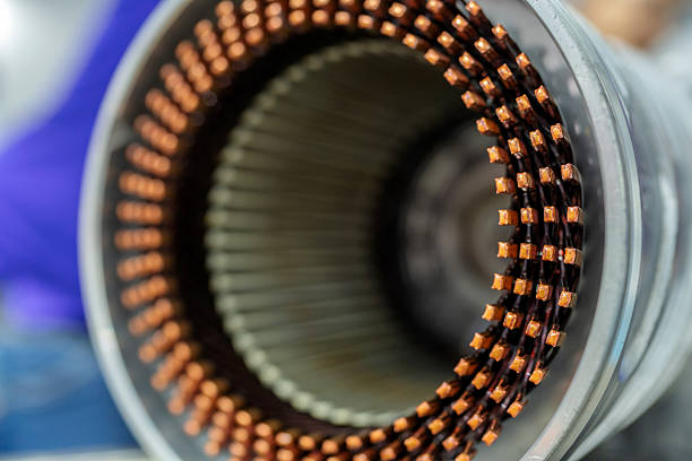
The primary challenge of hairpin welding is achieving stable, repeatable quality across thousands of weld joints in mass production. Copper's high reflectivity and thermal conductivity make energy absorption difficult, often leading to inconsistent weld quality with conventional joining methods. Laser welding overcomes these limitations by concentrating energy into a small area within milliseconds, creating a stable molten pool and achieving rapid metallurgical bonding with minimal heat impact.
The complexity of hairpin stator windings further increases welding requirements. Different weld positions and end-winding geometries can result in varying thermal conditions throughout the stator. To address this challenge, modern laser welding systems utilize adaptive power control, machine vision, and real-time process monitoring to ensure consistent weld quality across all joints. These technologies help reduce defects such as porosity, insufficient penetration, and excessive heat input.
Electrical performance is another key consideration. Weld joints are not only structural connections but also part of the motor's current path. Variations in joint resistance can increase energy losses and reduce overall motor efficiency. Laser welding produces dense, uniform metallurgical bonds with low and stable joint resistance, helping improve efficiency, reliability, and long-term performance. This advantage has made hairpin laser welding the preferred joining technology for many high-performance EV traction motors.
In addition, laser welding supports the transition toward intelligent manufacturing. Integrated with robotics, machine vision, and MES platforms, the process enables real-time quality monitoring and full production traceability. This level of automation and process control is essential for large-scale motor manufacturing, where consistency and productivity directly affect product quality and production costs.
The HGLaser LAP 8000CC Hairpin Motor Laser Welding System is specially designed for hairpin stator terminal welding in new energy vehicle drive motors and is compatible with I-pin, H-pin and X-pin hairpin designs. Equipped with an 8000W annular beam fiber laser, the system effectively suppresses spatter and porosity during pure copper welding, ensuring stable and consistent weld quality.
The machine features a large-field coaxial vision positioning system with positioning accuracy of up to ±0.01 mm. Each weld can be completed in as little as 0.3 seconds, enabling high-throughput stator production. Its large scan field allows complete full circumferential welding in a single clamping operation, while supporting fast product changeovers.
Compared with conventional welding processes, the LAP 8000CC significantly improves productivity while meeting weld strength requirements. It can operate as a standalone machine or be integrated into fully automated production lines and provides comprehensive process data traceability, making it an ideal solution for mass production of automotive drive motors.
Hairpin laser welding has become a critical enabling technology for next-generation EV traction motor manufacturing. By combining precise energy control, superior weld quality, and compatibility with automated production systems, it helps manufacturers improve both product performance and production efficiency. As electric motors continue to demand higher power density and greater reliability, advanced laser welding solutions will play an increasingly important role in supporting the future of electrification and intelligent manufacturing.
HGLaser is a pioneer and leading enterprise in industrial laser applications in China, as well as a globally recognized provider of laser processing solutions.
We focus on the development of laser intelligent equipment, measurement and automation production lines, and smart factory solutions, delivering integrated systems for advanced intelligent manufacturing.
With a deep understanding of manufacturing industry trends, we continuously expand our product portfolio and solution capabilities.
We are committed to the integration of automation, digitalization, intelligence, and manufacturing technologies, providing a wide range of industries with laser cutting systems, laser welding systems, laser marking equipment, laser texturing solutions, laser heat treatment systems, laser drilling machines, and supporting laser and plasma processing equipment.
In addition, we deliver complete solutions for special laser processing equipment, automated production lines, and smart factory construction.

