
HGTECH 武汉华工激光工程责任有限公司 privacy policy
Copyright HGLaser Engineering Co,.Ltd. All Rights Reserver.
As electric vehicles, lithium-ion batteries, fuel cells, and hydrogen energy technologies continue to expand, nickel mesh welding has become an essential manufacturing process. Nickel mesh is widely used in battery tabs, current collectors, fuel cell bipolar plate assemblies, and electrolyzer electrode assemblies, where it provides conductivity, heat transfer, and structural support. The quality of nickel mesh welding directly affects product performance, reliability, and service life.
Traditional welding methods, such as resistance welding and brazing, often struggle with ultra-thin nickel mesh, multilayer structures, and dissimilar metal joining. Common challenges include excessive deformation, large heat-affected zones (HAZ), and inconsistent weld quality. As manufacturers pursue higher energy density, lightweight designs, and greater reliability, laser welding has emerged as a preferred solution due to its precision, efficiency, and compatibility with automated production.
Nickel mesh laser welding uses a highly focused laser beam to deliver energy precisely to the weld area, enabling rapid melting and reliable bonding. The short interaction time significantly reduces heat input, minimizing distortion and preventing damage to delicate mesh structures. This makes laser welding particularly suitable for thin and precision nickel mesh applications.
By accurately controlling laser parameters such as power, pulse width, frequency, and welding path, manufacturers can achieve stable welding of single-layer and multilayer nickel mesh, as well as joints between nickel mesh and materials such as copper, nickel sheets, and stainless steel. The result is high weld consistency, strong mechanical performance, and low electrical resistance.
In the EV battery industry, nickel mesh welding is commonly used in cell connection components, battery module components, and Battery Management System (BMS)-related parts. Laser welding produces dense, uniform welds that improve electrical conductivity and connection reliability while supporting high-volume automated production.
In hydrogen energy applications, nickel mesh is widely used in alkaline electrolyzers, hydrogen electrolyzers, and fuel cell components. Because nickel offers excellent corrosion resistance and electrochemical stability, it is a preferred material for electrode manufacturing. Laser welding helps eliminate issues such as lack of fusion, incomplete welds, and excessive deformation, ensuring high-quality electrode assemblies and long-term equipment reliability.
The technology is also increasingly used in consumer electronics and precision electronic products, where micron-level welding accuracy and minimal thermal impact are critical for product performance.
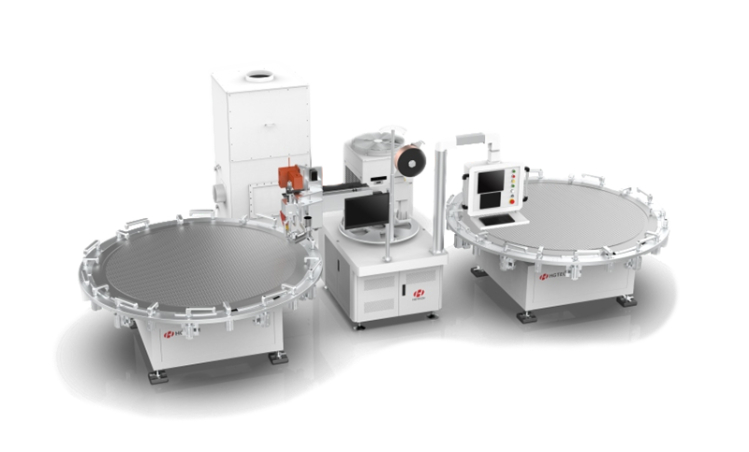
HGLaser's Nickel Mesh Laser Welding System is designed for the production of EV batteries and alkaline water electrolyzers (AWE), integrating automatic loading, positioning, welding, and unloading into a single intelligent process. Featuring high-precision laser welding technology, it supports both spot welding and continuous welding, achieving a welding yield rate of over 96%. The system is compatible with alkaline electrolyzer products ranging from 500 to 2000 Nm³/h and is equipped with real-time seam tracking and nickel-surface protection functions to ensure consistent weld quality and surface integrity. It is widely used in the manufacturing of nickel mesh electrodes, battery interconnects, and other critical components for clean energy applications.
As the EV battery and hydrogen energy industries continue to grow, nickel mesh welding is evolving toward higher precision, greater efficiency, and smarter manufacturing. The integration of advanced laser sources, machine vision systems, AI-driven process optimization, and digital quality control is further enhancing welding performance and consistency.
With its ability to deliver precise, reliable, and automated joining solutions, nickel mesh laser welding is becoming a key enabling technology for EV batteries, fuel cells, hydrogen electrolyzers, and precision electronics. Manufacturers adopting advanced nickel mesh laser welding solutions can improve product quality, increase productivity, and strengthen their competitive position in rapidly growing markets.
HGLaser is a pioneer and leading enterprise in industrial laser applications in China, as well as a globally recognized provider of laser processing solutions.
We focus on the development of laser intelligent equipment, measurement and automation production lines, and smart factory solutions, delivering integrated systems for advanced intelligent manufacturing.
With a deep understanding of manufacturing industry trends, we continuously expand our product portfolio and solution capabilities. We are committed to the integration of automation, digitalization, intelligence, and manufacturing technologies, providing a wide range of industries with laser cutting systems, laser welding systems, laser marking equipment, laser texturing solutions, laser heat treatment systems, laser drilling machines, and supporting laser and plasma processing equipment.
In addition, we deliver complete solutions for special laser processing equipment, automated production lines, and smart factory construction.

