
HGTECH 武汉华工激光工程责任有限公司 privacy policy
Copyright HGLaser Engineering Co,.Ltd. All Rights Reserver.
Robotic arm laser welding is an advanced manufacturing technology that combines industrial robotic arms with high-power laser welding systems. Through multi-axis motion control and high-energy-density laser beams, it enables high-precision welding along complex spatial trajectories. Compared with traditional welding methods, it offers significant advantages in precision, efficiency, and consistency. It is especially suitable for applications in automotive manufacturing, new energy batteries, construction machinery, and precision metal component processing. With the rapid development of intelligent manufacturing and automated production lines, robotic arm laser welding is becoming an increasingly important choice for high-end manufacturers to improve productivity and product quality, and it is also a key technological foundation for flexible production and unmanned factories.
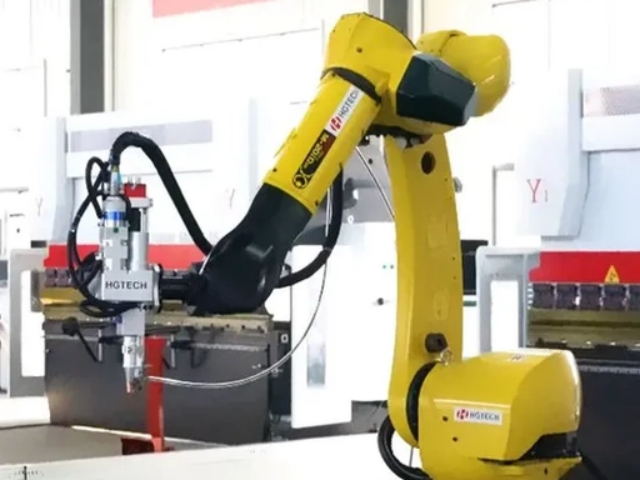
The core advantage of robotic arm laser welding lies in the combination of highly flexible spatial motion capability and the high energy density of laser welding. Industrial robotic arms typically have six or more degrees of freedom, enabling precise positioning of complex curved surfaces, deep cavities, and irregular weld seams. Laser welding, with its extremely small spot size and high power density, achieves rapid melting and solidification of materials, resulting in high-strength welds with minimal deformation. This combination not only significantly improves welding quality but also greatly reduces the cost of subsequent grinding and finishing processes.
In the new energy vehicle sector, robotic arm laser welding is widely used in battery pack structural components, busbar connectors, and motor housings. Since these components require extremely high electrical conductivity and structural stability, traditional arc welding or spot welding often leads to excessive heat-affected zones and severe spatter issues. Laser welding, however, enables more precise heat input control, effectively reducing material damage and improving product consistency. In the 3C electronics industry, this technology is also suitable for high-quality welding of stainless steel housings, precision connectors, and micro-structured components.
In addition, robotic arm laser welding systems are often integrated with vision recognition systems, sensor detection systems, and MES production management systems to enable automatic welding path planning, real-time quality monitoring, and production data traceability, thereby forming highly intelligent production units. This integration of digitalization and automation allows enterprises to maintain stable product quality while significantly improving production speed and equipment utilization.
From a process perspective, robotic arm laser welding also offers strong material adaptability, applicable to stainless steel, carbon steel, aluminum alloys, and certain highly reflective materials. By properly matching laser power and beam modes, various processes such as deep penetration welding, spot welding, and continuous welding can be achieved, meeting diverse industrial requirements. With the development of high-power fiber lasers and intelligent control technologies, this process is rapidly evolving from standalone automation equipment into flexible intelligent production lines.
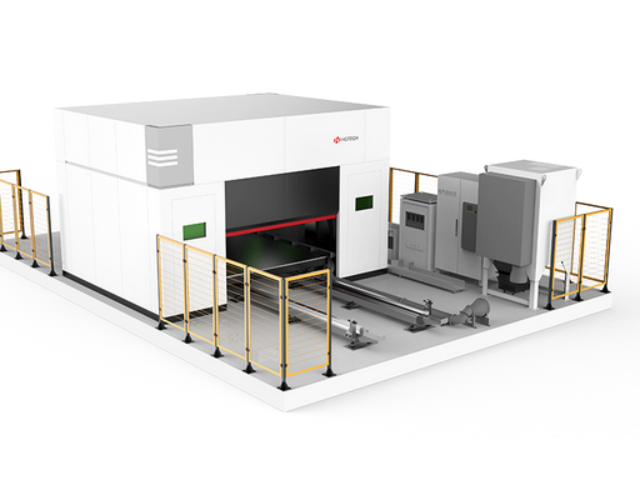
HGLaser JR-Tray is a six-axis robotic laser welding workstation for automated sealing welding of EV aluminum battery trays and enclosures. It integrates ABB or KUKA industrial robots with ±0.05 mm positioning accuracy and an in-house 1–6 kW fiber laser optimized for high-reflectivity aluminum welding, reducing porosity and spatter. The system features 3D vision seam tracking, online inspection, and automatic compensation for assembly deviation, supporting oscillation and filler wire welding. Controlled by a Siemens PLC, it includes safety enclosure and fume extraction. It delivers high flexibility for ESS enclosures, e-drive housings, and BIW parts, with >99% yield and easy line integration.
Overall, robotic arm laser welding represents an important trend in modern industrial welding toward high precision, high efficiency, and intelligent manufacturing. It not only overcomes the limitations of traditional welding in complex structural processing but also provides key support for flexible manufacturing and digital transformation. In the future, with the further integration of artificial intelligence control algorithms and machine vision technologies, robotic arm laser welding will play a central role in more high-end manufacturing fields and become a foundational process for smart factory construction. Meanwhile, system solutions featuring high stability, strong automation, and low overall cost will become key competitive factors in the market.
HGLaser is a pioneer and leading enterprise in industrial laser applications in China, as well as a globally recognized provider of laser processing solutions.
We focus on the development of laser intelligent equipment, measurement and automation production lines, and smart factory solutions, delivering integrated systems for advanced intelligent manufacturing.
With a deep understanding of manufacturing industry trends, we continuously expand our product portfolio and solution capabilities. We are committed to the integration of automation, digitalization, intelligence, and manufacturing technologies, providing a wide range of industries with laser cutting systems, laser welding systems, laser marking equipment, laser texturing solutions, laser heat treatment systems, laser drilling machines, and supporting laser and plasma processing equipment.
In addition, we deliver complete solutions for special laser processing equipment, automated production lines, and smart factory construction.

